

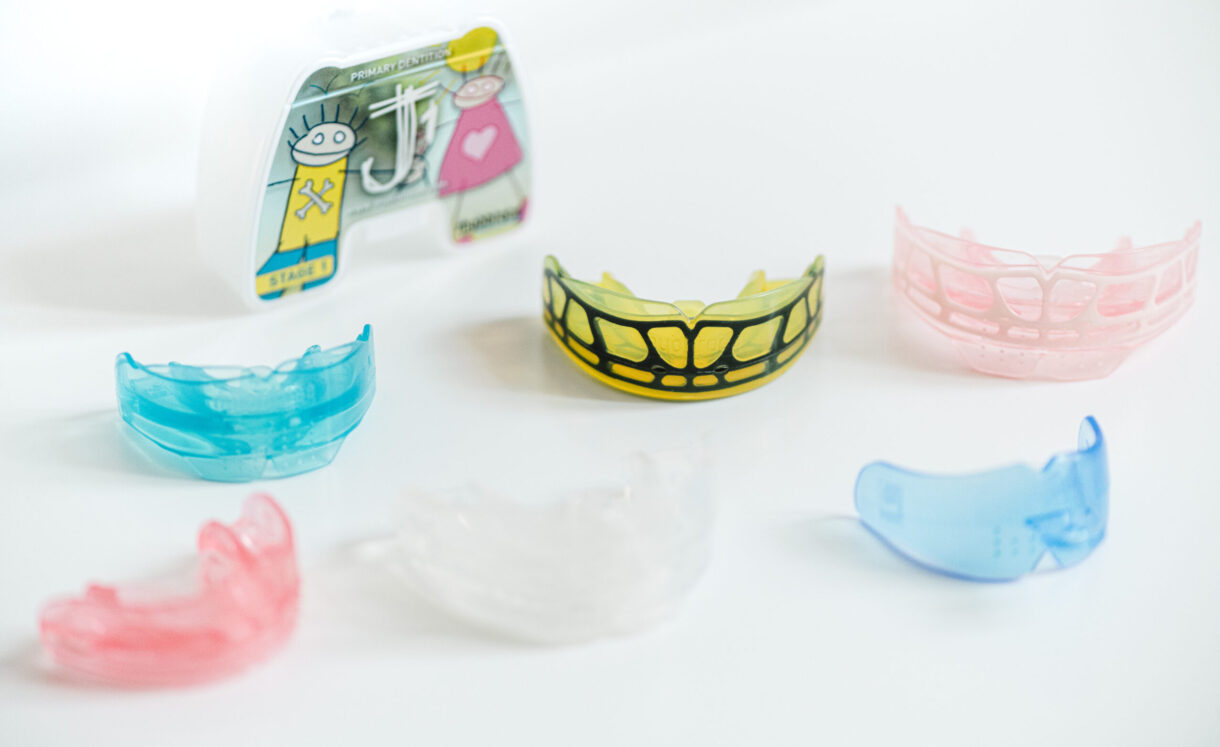
Myobrace appliances and treatment of orthodontic myofunctional anomalies in early age

Mouth breathing, tongue sticking, improper swallowing and finger sucking are the most common causes of tooth and jaw anomalies. Allergies, asthma and open bite also contribute to the misdevelopment of the jaw.
To solve this problem, we recommend a system of mobile braces that focuses on solving the root causes of incorrect position of teeth and jaws.
At the LiderDent Clinic, we offer the Myobrace system of removable devices that are worn for a minimum of 1-2 hours during the day and throughout the night while sleeping.
Myobrace is a system of removable appliances in various sizes that combine habit correction, arch expansion, and teeth alignment into one integrated system. It is suitable for all age groups, from juniors (as young as 3 years old) to adults (15+ years old, noting that the Myobrace system for adults has limited indications and is often not the device of choice). Treatment can start from an early age, as soon as poor myofunctional habits are recognized in children, such as thumb sucking or improper breathing, typically from the age of 3, if it is determined that the child can cooperate. If the child does not continuously wear their Myobrace devices as instructed, the desired result will not be achieved.
Patients are divided according to age into:
Juniors: 3 – 6 years
Children: 6 – 10 years
Teenagers: 10 – 15 years old
Adults: 15+ years (not always; this is reserved for rare indications, which will be defined by the orthodontist)
The best success is achieved in patients whose dental arches contain both baby and permanent teeth, usually children up to 10 years old.
How does the Myobrace system work?
Myobrace works by preventing the muscles of the cheeks, lips, and tongue from pushing the teeth as they grow in the wrong direction. It encourages nasal breathing and proper swallowing while keeping the mouth closed.
Myobrace therapy starts by correcting bad oral habits and works through a combination of three or more removable appliances to correct the causes of orthodontic problems.
Each Myobrace therapy is divided into 3-4 phases, which include:
- Correcting bad oral habits
- Arch development
- Bringing the teeth into alignment within the dental arch
- Retention/Maintenance of the achieved results
For each phase, a different appliance is used, provided that the previous phase has been successfully completed.
Since Myobrace appliances do not straighten individual teeth, the final alignment may include treatment with fixed braces. In such cases, the fixed braces are worn for a much shorter period compared to what would be required without the prior Myobrace treatment.
Also, a special feature of this appliance is that it can be combined with fixed braces during teenage years and for adults. Due to the imbalance between the jaws, it is possible to wear fixed braces that straighten the teeth and care for aesthetics, while simultaneously using Myobrace appliances, which move the muscles that previously hindered proper tooth growth, thus caring for muscle function. Additionally, a device specially designed by the same company may be indicated for snoring, bruxism (teeth grinding), and temporomandibular disorders (TMD).
The therapy ends with the retention phase, where the goal is to maintain the results and good oral habits achieved. The duration of the therapy is highly individual and varies from case to case. Based on the experience of our patients, each phase lasts on average 6 months. Check-ups are mandatory every 8 weeks, and it is necessary to bring the Myobrace appliance to the check-up. The Myobrace system for the initial phase is made of flexible silicone material that allows adjustment to the appliance, while the appliance for the final phases is made of firmer polyurethane material,
which ensures the most effective final results and retention of the achieved results. It takes a certain amount of time to adjust to the appliance, on average about ten days or more. Generally, with children during the adjustment period to classic removable appliances and/or Myobrace appliances, it is necessary to check their nighttime wear because children often remove the appliance while sleeping. If it is not worn enough during the day, it will fall out at night, and you may often find it under the bed. For this reason, parental cooperation is essential. During meals, the appliance must be removed. The removable appliance should always be worn on clean teeth. When not in the mouth, it should be stored in a box specially designed for removable appliances.
Principle of action!
Myobrace appliances, from the aspect of biological dental medicine, represent myofunctional therapy for children. A removable appliance harmonizes all neuro-vegetative functions in children and holds the highest place in the treatment of myofunctional orthodontic anomalies. Great attention is paid to the primary neuro-vegetative functions (chewing, breathing, and swallowing) and their rehabilitation from an early age.
1. Swallowing
This is the first function we perform even during the embryonic period. Swallowing usually occurs, along with the sucking reflex, around the 12th week of gestation. This reflex must mature by the 25th week of pregnancy, and at birth, the child must be able to properly suck and swallow. We swallow between 1,200 and 1,400 times per day, and during this rhythmic and vital act, the tongue must have support and exert force directly on the palate. Unfortunately, what happens, and the literature confirms, is that habits like tongue thrusting associated with infant swallowing are present in more than 30% of school-aged children. Atypical swallowing causes protrusion of the upper incisors, delayed eruption, and transverse micrognathism due to the tongue pushing forward during swallowing. The consequences on the orofacial development of growing children are very striking, and this approach to treatment pays special attention to teaching proper swallowing as early as possible. These appliances train swallowing and guide the tongue into the correct position.
2. Breathing
Breathing is the first thing we do as soon as we are born. Breathing is the most important neurovegetative function of all since a newborn can hardly survive longer than a minute without breathing. A little-known aspect of breathing is that if we cover a newborn’s nose and allow it to breathe only through the mouth, it will die within a few minutes. The explanation for this phenomenon is clear: we are born predisposed to nasal breathing; a newborn cannot breathe through the mouth. The harmful habit of mouth breathing will be acquired by the child in the first months of life due to nasopharyngeal obstructive problems, primarily hypertrophy of the adenoids and/or tonsils or excess mucus from repeated colds that block the passage of air through the nose.
Similarly, the consequences of mouth breathing on the craniofacial and overall development of the child become apparent at an early age and are always accompanied by malocclusion.
Posterior head rotation, dorsal kyphosis, lumbar lordosis, and other postural problems that arise from the child’s habit of mouth breathing are very common. Sleep disorders (snoring and apnea) are also common and often affect these children’s academic performance.
In a recent study published on 1,200 schoolchildren, they found a prevalence of 38% of oral respiratory diseases. This research analyzed the most common conditions in childhood, such as colds, tonsillitis, otitis, and allergies in general. The results were convincing, as children who breathe through their mouths catch more colds, suffer from more infections diagnosed by ENT specialists, consume twice as many antibiotics annually, and suffer three times more from allergic diseases simply because they do not use their noses, which is the natural air filter.
In the same study, pulse oximetry was used to measure oxygen saturation in the arterial blood of all participants. They found lower oxygen saturation in those who breathed through their mouths compared to those who breathed properly through their noses. It is not surprising, given the lack of oxygenation, that a large number of developmental problems appear due to the bad habit of mouth breathing.
We can claim, having studied mouth breathing for more than 10 years, that it is an epidemic that is not receiving attention. We monitor the growth and development of children and observe changes that occur in their faces when oral habits change. Such children are often treated in a multidisciplinary way together with pediatricians, otolaryngologists, and speech therapists.
According to the WHO, in adulthood, more than half of the population uses mouth breathing to some extent. The consequences, in addition to insufficient oxygenation, also include changes in the oral biofilm. The continuous passage of air through the mouth transforms the moist ecosystem of the oral cavity into a dry one. Currently, research is ongoing regarding the physicochemical changes that occur in saliva in conditions of mouth breathing and dry mouth, and how this environment leads to an imbalance in the oral bacterial flora. Initial clinical results using mobile appliances for saliva stimulation have proven to be very effective in controlling periodontal problems and various pathologies of the oral mucosa. Another aspect that should be considered, closely related to mouth breathing, is sleep disorders. It is common knowledge that if we sleep with our mouths open, snoring is inevitable. Recent studies conducted by the Sleep Research Department at the University of Granada show that almost half of the adult Spanish population suffers from obstructive sleep apnea, and nearly three billion euros are spent annually on healthcare for this condition. Sleep problems are becoming more common in today’s society, and as such, they are a risk factor for other types of illnesses.
Myofunctional therapy brings the lower jaw into a natural, favorable position that opens the airways and teaches children to breathe through their noses. Breathing and swallowing exercises are indispensable in the treatment process for these patients.
3. Chewing
Chewing is the process by which food is cut (by incisors and canines), crushed and ground (by premolars and molars), tasted, and mixed with saliva to form a bolus before swallowing.
We can say that chewing is the most important part of digestion; it is the pre-digestion phase. The more time is spent on this, the more contact the food has with saliva enzymes (alpha-amylase, lipase, etc.), and the less effort the rest of the digestive system will need to complete the process.
In recent decades, we have witnessed a drastic reduction in the function of chewing for various reasons. The food industry offers us more and more processed, minced, and mixed products that do not require much chewing effort. Additionally, the current pace of life leads to fast eating, with less time spent on this important function. At the beginning of the last century, we spent an average of three hours a day chewing, and today we barely reach one hour. We eat everything soft, and, even worse, we wash it down with carbonated drinks to help food slide into the stomach, thus reducing effort.
On the other hand, science is clear here as well: exercising the act of chewing increases blood flow to different areas of the brain, and the longer food remains in the mouth, along with proper bilateral chewing, the higher the levels of hemoglobin in the brain. Research by Momose from the University of Tokyo on chewing confirms this, showing that various areas of the brain increase their oxygenation by over 25% simply by chewing for 20 minutes.
Digestive well-being, saliva production, parasympathetic activation, and oxygenation provided by proper chewing engage and concern all aspects of biological dental medicine, which places special emphasis on activating this primitive function that has been lost. Let’s not allow our chewing muscles to atrophy. In short, we could say that in the times we live in, neither the nose is good for breathing nor the mouth for chewing, and saliva production in humans is decreasing. Along with altered neurovegetative functions that dry out the mouth, we must also add the more than 500 daily medications, along with tobacco and alcohol, that alter both the quantity and quality of our saliva. And we must not forget that the biology of saliva is synonymous with health.
For all these reasons, biological dental medicine has emerged, occupying a significant place in the healthcare system that has so far been neglected, but which provides a better quality of life for many patients. It is time for dentists to take the leading role in re-educating these functions that affect the oral and overall health of the population and get to work because dentistry must first and foremost be medicine.
Let's do the best for our children!