

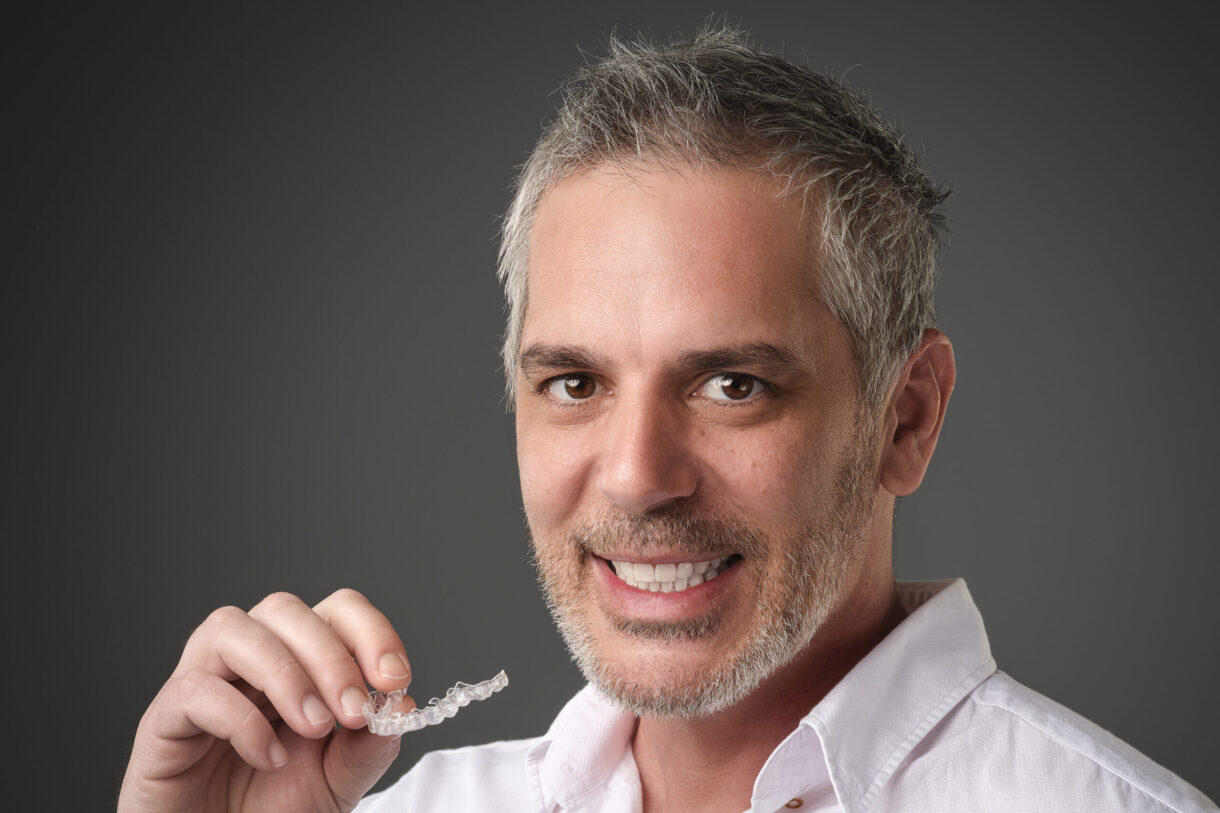
Aligners are the present and future of orthodontics
Dental tribune, interview.
1. Can you tell us more about what oral health is, why it is important, and what teeth straightening actually is?
Oral health involves the function and aesthetics of the smile, along with healthy teeth and surrounding structures of the stomatognathic system. Orthodontic anomalies are a frequent topic and focus of the fashion industry. Today, every other child has pronounced irregularities within the dental arch, jaw, or face, and anomalies are also noticed in a large number of adult patients. Early intervention in the mixed dentition can prevent later tooth extraction, gain more space for permanent teeth, reduce the possibility of impacted teeth, correct irregularities such as reverse or crossbite, increased overbite and overjet, establish symmetry, and myofunctional stability. Orthodontic treatment at a younger age in the mixed dentition has great benefits, and there is a significant parental investment in their child's future.
Every therapy is, of course, unique because every anomaly is unique. Therapy at that age is interceptive and it is necessary to assess the psychological and emotional readiness of the young patient to cooperate. There is no age limit for orthodontic therapy, so it is possible to have the first orthodontic examination whenever the patient feels ready. Periodontitis and osteoporosis, as well as temporomandibular disorders in the acute phase, are common in adult patients and are an absolute contraindication for therapy with aligners as well as braces. Initial periodontal therapy and initial splint therapy should precede orthodontic therapy. I attach great importance to cooperation with dental colleagues who refer their patients for orthodontic therapy. It should be known that therapy lasts an average of 22 months, depending on the age and size of the anomaly, and during that period, check-ups with the dentist are essential. Our cooperation is crucial for mutual satisfaction. Before entering orthodontic therapy, we perform a protocolized diagnosis for the patient (scanning of teeth and visualization before and after, high-resolution set of photographs, orthopantomogram, teleradiography, and an analysis of a large field CBCT). Diagnostics can reveal dental, skeletal, or myofunctional problems. It is important to know that endodontically treated teeth, inflammatory and non-inflammatory periodontal diseases need to be under control throughout orthodontic therapy, the pretreatment reconstruction of teeth needs to be temporary regardless of the type of prosthetic work, and multidisciplinary rehabilitation needs to be agreed and included in the therapy plan.
After orthodontic therapy, professional rules dictate that all teeth be set according to the given concept, taking care of the position of teeth in the bone, predicted tooth and jaw growth, respecting the concept of occlusion and canine guidance, centered joints, and both jaws in the correct skeletal position, taking care of soft tissues that condition facial aesthetics. The dentist and orthodontist work together as a team in planning the therapy of each patient.
After orthodontic treatment, the dentist completes pre-planned prosthetic or implant-prosthetic therapy with adult patients, as well as check-ups and treatments for children.
Digitalization has greatly helped and facilitated the process. Scanners, CBCT devices, and printers, as well as high-resolution photographs, and the connection between the dentist, orthodontist, and technician, have greatly helped in creating a beautiful smile.
2. What exactly does your clinic do, what options for correcting teeth do you apply, and why?
LiderDent Clinic is registered for orthodontics and oral surgery with two specializations in the ownership structure. Orthodontics without oral surgery is unthinkable for me. My clinic is designed for a small number of patients, interdisciplinary cooperation with colleagues, and a high standard of service. Working as an orthodontist for many reputable clinics for many years(in which I am still an educator and expert collaborator) my lifestyle, beliefs, and dreams have led me to establish "my little clinic" in which I strive to create small masterpieces and smiles that neither I nor my patients will be ashamed to show the world.
It is important that the necessary rehabilitation and therapy plan, as well as medical test results, are completed correctly and in collaboration with a dentist, endodontist, prosthetist, surgeon, maxillofacial surgeon, often a speech therapist, ENT specialist, and physiatrist before starting orthodontic treatment. The concept is not just about correcting tooth misalignment, but also includes complete musculoskeletal and dental rehabilitation, as well as the aesthetics of the lower third of the face. Patients should be fully educated about each procedure and ready to cooperate.
Young patients usually need to establish proper myofunction while they are growing and developing, while adults need jaw correction and teeth straightening as well as functional restoration, and the largest group often seek facial aesthetics and a broad white smile that requires orthodontic preparation for other specialized branches. During and after orthodontic treatment, many small surgical procedures are necessary to ensure that the teeth and gums meet high aesthetic standards.
My colleagues are often my clients, or they themselves are in therapy, or their families or patients. They bring their patients and require my expertise, knowledge, and collaboration. I often choose the type of orthodontic appliance to use myself, to create a smile that will not leave them indifferent.
I most often use braces, and prefer the "Damon system," which really pays off if you know how to work with it. The Myobrace mobile appliance is the best choice for myofunction in children.
Hyrax and SARPE are a common therapy plan for adults with maxillary hypoplasia. Orthognathic surgery is necessary for many. Aligners are the future of orthodontics. I often like to emphasize that devices are just tools and should not be mentioned in superlatives.
Invisalign aligners are my only choice out of the 10 aligners I have tried in 12 years of working with them. I even tried to make some myself, but the technician in me wouldn't let it go.
The Invisalign aligner system has many advantages. Every detail of the device is precisely developed in the manufacturing, application, delivery, diagnosis, presentation, and, of course, it has the strongest marketing tool that works for us. It is the aligner that is most comfortable for the patient and a brand that the patient loves. So far, no other aligner can compete with it in diagnosis, production, therapy, or marketing. Every orthodontist who has experience working with aligners and practices their profession correctly knows very well the advantages and disadvantages of this system. It is a completely different concept of biomechanical tooth movement than working with braces, although the basics of biomechanics are the same. Some movements are easier to make with aligners, while others are easier with braces. This requires special knowledge and extensive clinical experience. Rare anomalies can be treated with a small number of aligners or just aligners. In my Invisalign aligner therapy, I often use a large number of aligners, but I also have demanding anomalies, and the therapy often lasts more than two years. Therefore, it is important to know that it is not just the aligner that moves the teeth, nor the software, but the orthodontist who is skilled in it. This is a matter of knowledge, experience, and expertise.
3. Who is behind Invisalign? Why do you consider it useful compared to other products on the market, B&W?
Invisalign® clear aligners are represented by the American company Align Technology, which is dedicated to continuous innovation, with 20 years of clinical research and over 700 patents. No other aligner on the market has been tested on over 4 million cases. The SmartTrack® material and SmartForce® technology have been clinically proven to achieve predicted tooth movement. The advantages of Invisalign aligners are fewer visits to the orthodontist, greater comfort for the patient, and more confidence for teenagers during the treatment process compared to wearing traditional braces. They have special blue dots on the aligners, called wear indicators, which help assess compliance in children and teenagers. The iTero intraoral scanner is crucial in defining the plan for orthodontic treatment. The orthodontist moves the teeth and adjusts the number of aligners, not the software that only simulates them in a virtual slow-motion projection called ClinCheck. It is crucial for the orthodontist to match the virtual contacts in the software with those that are actually achieved inside the patient's mouth. Tissue biology is not the same as virtual software simulation, which can sometimes be challenging. The number of aligners varies based on the patient, and depends mostly on the type of anomaly. Aligners are changed weekly and need to be worn for 20-22 hours a day. After the last aligner, the orthodontic therapy continues with the retention phase to maintain the achieved results. The Vivera retainer, created by Invisalign, is an excellent choice. I often use a fixed retainer in the lower jaw because the type of anomaly requires it, and my choice is a cast titanium retainer.
There are various effective and less effective orthodontic systems of clear aligners on the market. The Invisalign aligner system, its vision, long-standing competence, and technology have reached a much higher level in every aspect than any aligner system on the market.
Aligners are the present and future of orthodontics. This new technology is a revolution in the world of dentistry and orthodontics in the 21st century. Many have contradictory opinions about this orthodontic technique. Many will never face the future. However, the emergence of new technology in tooth movement does not mean that the 150-year-old orthodontic principles are no longer valid. The general principles of bone biology, biomechanics, anchorage, and occlusion remain the same. Teeth are moved according to sophisticated computer algorithms developed in software that advances day by day. The system uses biological forces, and the device satisfies aesthetic and hygienic standards. Many aligner systems are being developed worldwide, and it is evident that this will be the future of orthodontics. It is essential to understand that clear aligner therapy is a technique, not a product.
4. What has changed exactly for your patients, your business, and overall experience since your clinic became fully digital?
Orthodontists who invest in their knowledge and profession know very well what it means to keep up with the times. The rapid progress in the field of digital orthodontics has changed the work protocols in a modern clinic. The fact is that we need to constantly keep up with the times if we want to be omnipresent in the world of technology. Today, the success of our therapy is based on correct 3D diagnosis and treatment planning, digital tooth movement design, virtual bite, and a predictable treatment plan, which requires a great deal of knowledge and experience to achieve high treatment goals. Today's patient has high expectations, and we must be ready for that. As we learn to use the power of the digital world to move teeth and design bites to a degree of accuracy, we never thought possible, we must not forget that the basic principles of our orthodontic profession are grounded in the fundamental principles of the profession, and orthodontic therapy should not be part of the fashion industry. My patients are thrilled with scanning, visualization, and 3D technology. They receive complete diagnostics presented through a 3D scan, iTero scan, high-resolution photos, and with one click in the software, a complete visualization of their smile before and after orthodontic therapy. With a little knowledge and marketing skills, the patient no longer thinks twice.
5. Who can we turn to in Croatia to get Invisalign?
Orthodontists today mostly struggle with various techniques in order to achieve therapy stability, while on the other hand, orthodontics is emerging as a new fashion trend available in all dental medicine offices. When you ask an orthodontist who is passionate about their profession where to get Invisalign in Croatia, my answer is to find a competent orthodontist who is a virtuoso in this technique, rather than finding the product. You are not buying a product, but knowledge and skill in working with it. The stability of orthodontic treatment results depends on the plan and success of orthodontic therapy. Aligner therapy is just an orthodontic technique. As such, orthodontic principles of force application, anchorage, and biomechanics must be applied as in brace therapy and can only be performed by an educated orthodontist. Each orthodontic therapy must meet criteria for aesthetics and function. It is up to the patients to choose the orthodontist first, and then the system.